
08 · Research
Cosmopolitan Sounds and Intimate Narratives in P. Ramlee’s Film Music
Adil Johan
Johan, A. (2019). Cosmopolitan sounds and intimate narratives in P. Ramlee’s film music. Journal of Intercultural Studies, 40(4), 474–490. https://doi.org/10.1080/07256868.2019.1628723

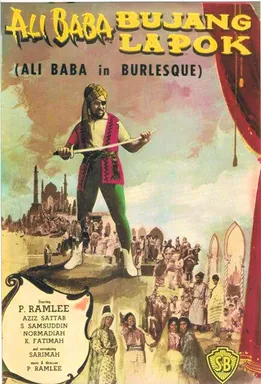
This article presents an analysis of the film music in Ali Baba Bujang Lapok (1961) directed by P. Ramlee which unravels the threads of cosmopolitan musical practices and culturally intimate expressions that challenge the rigid boundaries of the nation-state; expressing a unique inter-regional, multilinguistic and multiethnic collective identity.
Objectives
- A history of diverse musical practices that form a Malay aesthetic or style characteristic of independence era films is contextualised using cosmopolitanism as the conceptual framework;
- Cultural intimacy and local Malay sentiments of ‘kasih’ (love) and ‘kasihan’ (pity) are explored in light of the iconicity and nostalgia for P. Ramlee;
- Cross-cultural intimacies unique to the Malay-speaking region are gleaned from the music and narrative of the anachronistic comedy-film, Ali Baba Bujang Lapok, directed by P. Ramlee in 1961.
Findings and discussion
Cosmopolitan musical practices in the Malay Peninsula were eventually adapted for the sounds of vernacular Malay films of the 1950s and 1960s.
Getaran Jiwa
The sense of idealism, both fixing a sense of primordial nationalism while continually challenging it, is encapsulated and reenacted in every performance, rendition and recording of the song.
The ‘kasihan’ sentiment
There exists in Malaysia a collective public embarrassment of P. Ramlee’s neglect – expressed through a tragic ‘kasihan’ narrative – by both the state and its citizens, that fuels a sense of nationalist ‘pride’ and his ubiquity in the embodiment of Malaysian-ness.
Conclusion
The intimate expressions extracted from cross-cultural and intertextual linguistic and spiritual references in Malay film music operate paradoxically to contest the rigid boundaries of ethno-nationalism while providing an inclusive artistic space for a local, regional and multiethnic collective identity.