
08 · Research
P. Ramlee’s Music: An Expression of Local Identity in Malaya during the Mid-Twentieth Century
Clare Chan Suet Ching
Chan, C. S. C. (2012). P. Ramlee’s music: An expression of local identity in Malaya during the mid-twentieth century. Malaysian Music Journal, 1(1), 16–32.

In this article, it is argued that although P. Ramlee’s music mainly utilised Western musical instruments, tonality, and harmonies, his music was also localised to the flavour of the Malay, Chinese, Indian and Arabic communities through the utilisation of rhythmic patterns and melodic modes associated with these communities. The article examines the unique ways in which these culture related rhythms and modes were infused into a Western tonality and temperament. It also posits that P. Ramlee’s music embodies and manifests the local identities that were already eclectic in nature.
Zapin in ‘Semerah Padi’
In the song ‘Semerah Padi’, the zapin rhythm represents the Malay identity to manifest the energy, spirit and ethos of the Malay community who dominated the agricultural sector during the pre-Independence period. The film begins with the vibrant and energetic zapin rhythm played on the frame drums. It accompanies a homophonic musical arrangement based on Western diatonic scales. The musical style of alternation between a solo singer and chorus arranged in typical Western musical structures is also utilised.
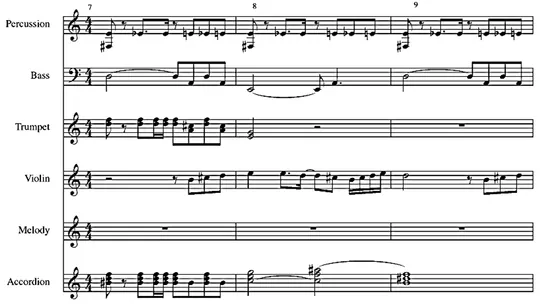
Joget rhythm in ‘Joget Malaysia’
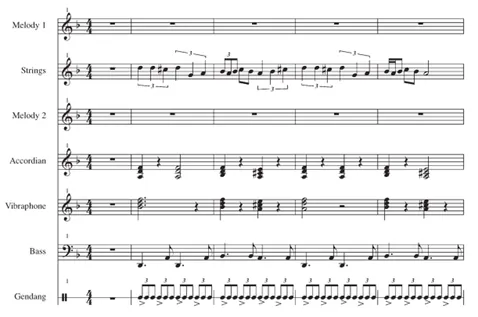
An example of how joget is combined with Western musical instruments and tonality is ‘Joget Malaysia’ from Ragam P. Ramlee (1964). The strings and gendang manifest the joget rhythm by performing triplets in duple time, a three-against-two rhythm.
Beguine in ‘Antara Dua Darjat’
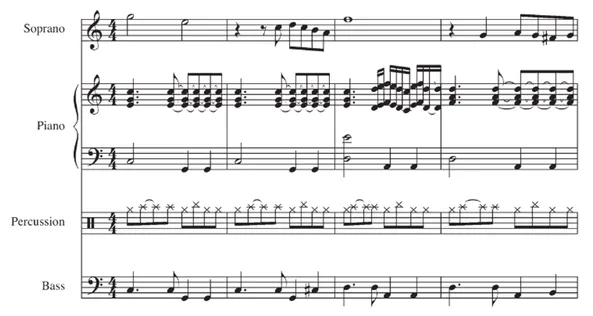
P. Ramlee uses the beguine rhythm to accompany ‘Getaran Jiwa’, which is arranged in a Western homophonic style based on the diatonic scale. Beguine is the national dance from Martinique in the West Indies, which is sung in slow polka with a dotted rhythm (Gammond, 1991, p. 49). The beguine rhythm is created by combining various Western instruments. A syncopated rhythm is played by the claves and bass drum. The bongo and the maracas interlock with the syncopated rhythm by providing the downbeat patterns.
Waltz in ‘Tolong Kami’
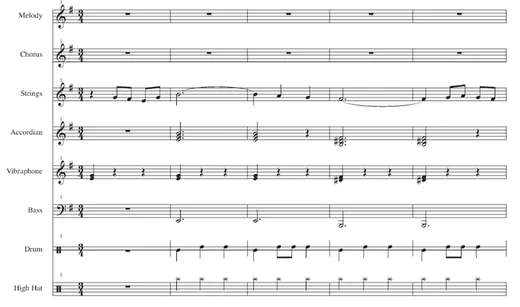
In ‘Tolong Kami’, a variation of the waltz rhythm pattern is employed in the drum section. The waltz accompanies a homophonic musical arrangement based on Western diatonic scales. The transfer of discrete musical traits and syncretism is observed in the combination of a Western rhythm, Western musical instruments, Malay song text, and a minor feel.
Conclusion
P. Ramlee utilised excerpts from scales and melodies from Chinese, Arabian and Indian cultures, which were based on Malay, Arabian, Chinese, Indian, and Western epics or folk tales. He incorporated the scales and modes to create culture-related character stereotypes, and to evoke the ambience and flavour of these various cultures. Excerpts of Western popular tunes were also adapted into some of his songs. His music appealed to the multicultural communities because it embodied qualities that reflected a harmonious state of living much desired, imagined and perhaps lived during his time.